
While glass fiber composites possess high strength, their toughness is relatively low. Fatigue testing involves mechanically pulling a specially designed glass plate up and down to assess its properties. Xi'an Huode has designed a visual monitoring system for fatigue testing of glass fiber composites using machine vision technology.
Function:
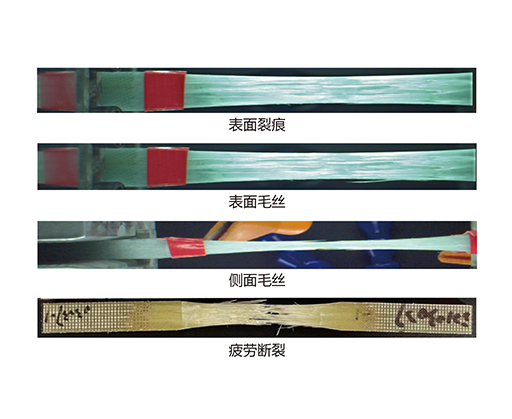
The material to be inspected will experience four types of deformation failure, and all four types of deformation will occur on three surfaces: A, B, and C. Based on communication with the client, the requirements are as follows:
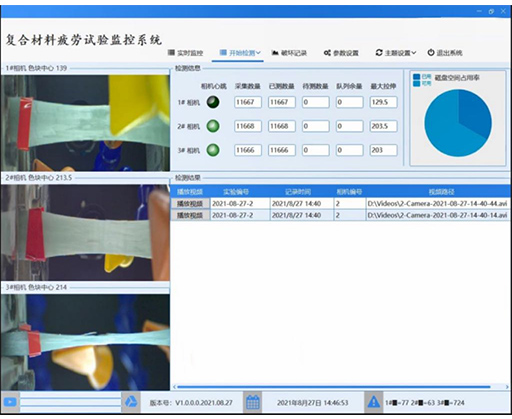
1. Fully automatic recording, video compression, automatic video editing, and automatic video sorting; the video monitors the sample from three directions, and the videos at the same time have a one-to-one correspondence.
2. The fatigue tensile testing apparatus used in the experiment has a vibration frequency of 1-5Hz. It is required to record video at the instant the material under test undergoes deformation, with a required detection accuracy of 0.1mm. The recorded content includes video files of 5 seconds before deformation, the instant of deformation, and 5 seconds after deformation; simultaneously, an audible and visual alarm should be triggered at the moment deformation is detected.
3. Video Recording Function: This function is divided into two subsystems. Subsystem 1 needs to implement full-process recording. After the system starts, it checks whether full-process recording is required. If so, the system automatically starts recording all images captured by the three cameras, naming the file after the program's start time and the camera's location. Recording automatically stops when the system exits. Subsystem 2 needs to implement segmented recording. After the system starts, it checks whether segmented recording is required. If so, it automatically starts recording based on whether the start time has been reached. The file name is named after the start time and the camera's location. It starts recording all images captured by the three cameras and stops recording when the end time is reached.
4. After the detection system completes the detection, operators can view the video from a specific time period and choose the playback speed, such as 0.5x speed. The duration of each detection is not fixed, ranging from a few hours to a month.
5. On the system software platform, the start and stop of the detection platform can be manually controlled, and the detection parameters can be displayed on the software. The software system needs to support permission management functions and be able to export reports at the moment of deformation and failure.
 Inquiry Hotline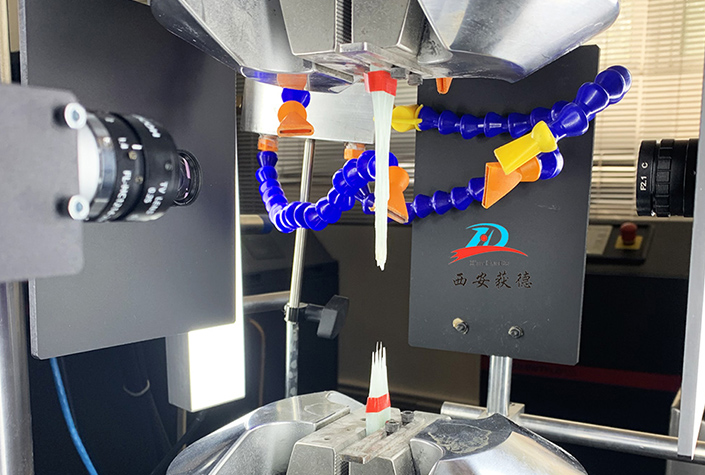
 All Products
Online message